


The Single Stretch that Immediately Improves Walking Pain and Distance for Spinal Stenosis


The most effective stretch I have found to improve walking with spinal stenosis is the Standing Hip Flexor-Hamstring Stretch. By alternating between extending the hip and flexing the spine using a chair, you open up the spinal canal and restore blood flow to compressed nerves. This simple movement helps reduce "neurogenic claudication" (heaviness and pain) without requiring you to get on the floor.
The Hip Flexor-Hamstring Stretch
This exercise works because it attacks the problem from two angles: it stretches the tight hip muscles that force your back into a painful arch and are required for walking, and it opens the spine to relieve nerve pressure. Bingo! Here's a video that reviews it!
You don’t need any fancy equipment. All you need is a chair with a back.
- Safety First: Make sure the chair is sturdy.
- Position: Stand facing the chair and have the back of it within reaching distance so you have something to hold onto for balance.
Part 1: The Hip Flexor Stretch
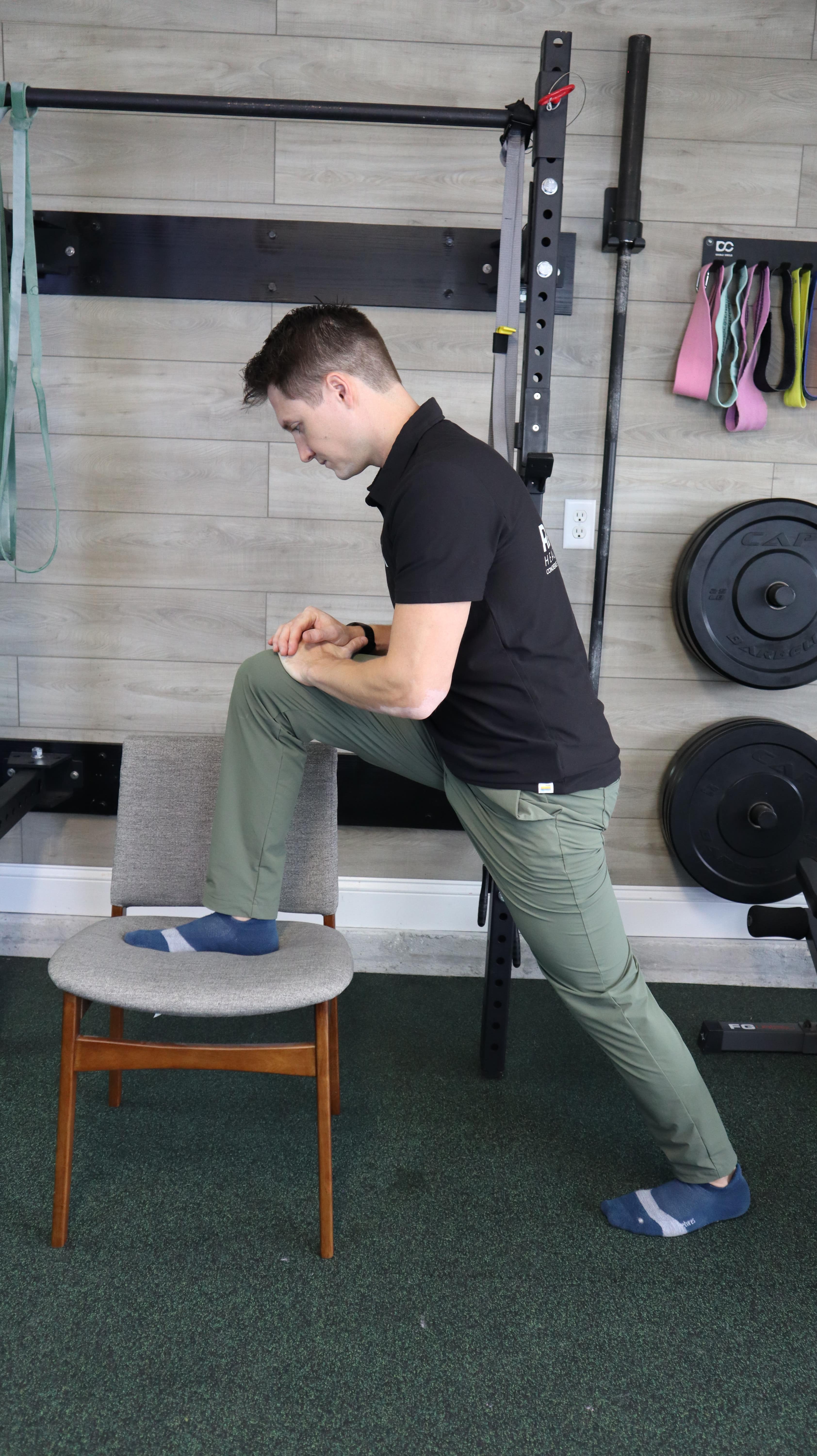
- Place one foot up on the chair. Your knee should be bent at roughly a 90-degree angle.
- Keep your other foot (the stance leg) behind you. It is okay if your heel comes off the ground.
- Stand tall.
- The Movement: Shift your weight forward just until you feel a gentle stretch in the front of the hip of the leg that is on the ground.
- The Hold: Hold for only 1-3 seconds, then back off.
Part 2: The Hamstring Stretch
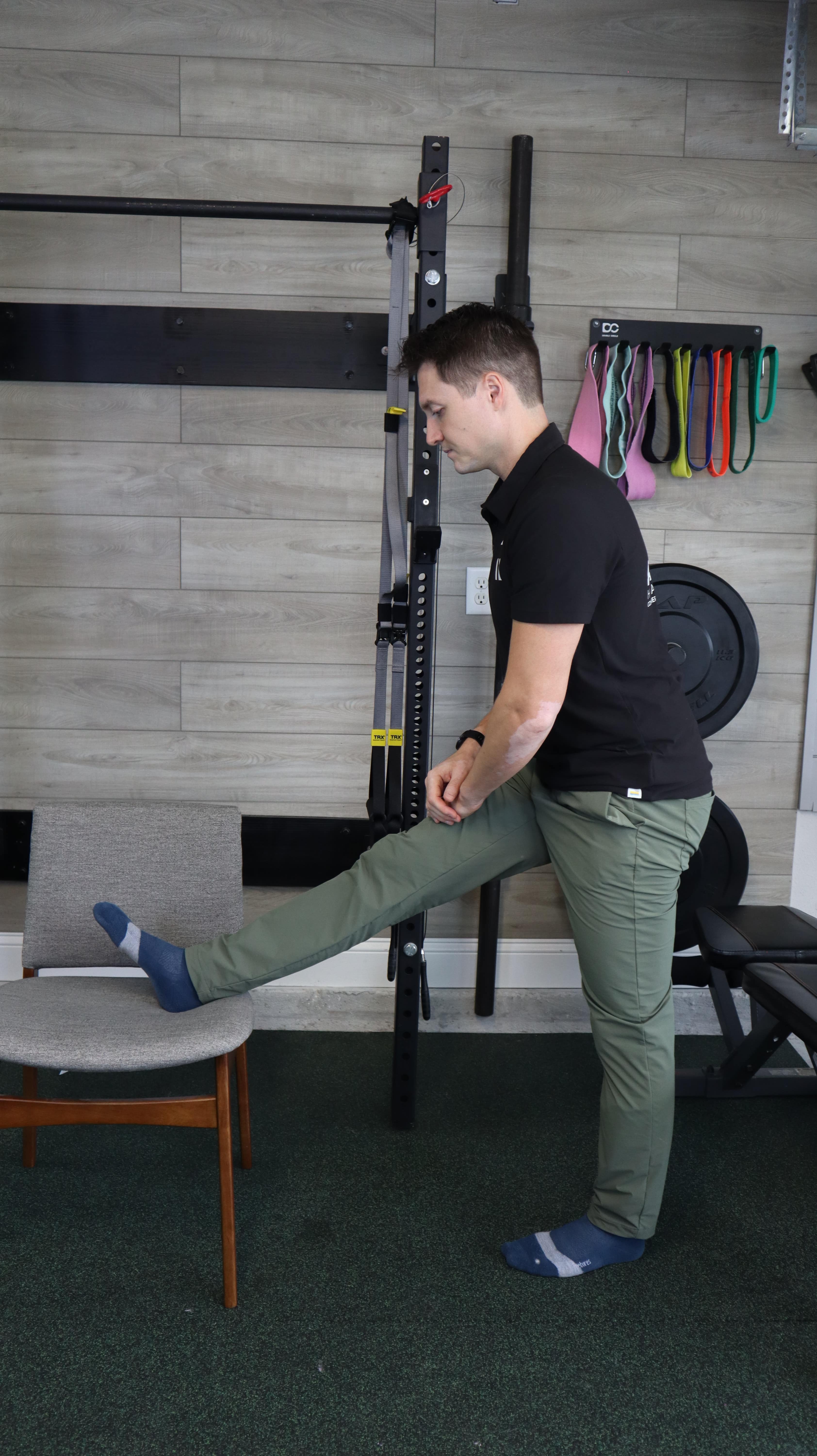
- From the forward position, shift your weight backward.
- Straighten the front leg (the one on the chair) and lean your chest forward slightly.
- The Movement: As you lean forward, think about rounding your back slightly. Flexion is your friend! This opens the spine while stretching the hamstring.
- The Hold: Hold for 1-3 seconds, then shift forward again.
Reps and Sets I recommend doing 10- 20 repetitions (rocking forward and backward counts as one rep) on each leg immediately before you go for a walk.
Expert Tip: "Motion is lotion." Keep this moving rhythmically. We are trying to pump blood flow to the nerves and gently mobilize joints.
What You Should and Should NOT Feel During the Stretch
When performing this stretch, the golden rule is simple: You cannot have any back pain or leg pain. It should be pain-free!
You should only feel a stretch.
- Correct Feeling: A pulling sensation in the front of the hip and the back of the thigh.
- Incorrect Feeling: Sharp pain in the back.
If you feel a pinch in your back, you are likely pushing the stretch too much. I have had patients do this. Less is more sometimes!
Why Does Walking Hurt with Spinal Stenosis?
Walking is fundamentally an extension exercise. When you stand tall and step back, your lower back arches or extends, which narrows the spaces in your spine. If you have stenosis, it can close down your nerves. While a necessary and safe movement of your spine, it can be painful when you walk. Pain is often felt during walking and may worsen as you continue to stand or walk. Until you start improving your nerves and spine, which I cover in my book!
Stenosis and Arthritis are just "Wrinkles on the inside."
I tell my patients all the time: what they see on images like arthritis or stenosis is often just "wrinkles on the inside." Just as we expect to see wrinkles on our skin as we age, we expect to see changes in our spine. These are structural "wrinkles," and they often don’t cause pain. But sometimes they do! It really depends.
Functional vs. Structural Spinal Stenosis
It’s worth remembering that you are not your MRI. A "structural" narrowing on a scan doesn't always equal "functional" pain.
It’s very common to be told you have stenosis on an image but no pain from it. An image is only one small piece of diagnosis. When my patients have pain from stenosis, that’s functional stenosis. We diagnose this with testing, walking, and more. It’s a clinical diagnosis in that it requires a clinical exam.
Side Note: If someone says you have stenosis and they don’t test you, get a 2nd opinion!
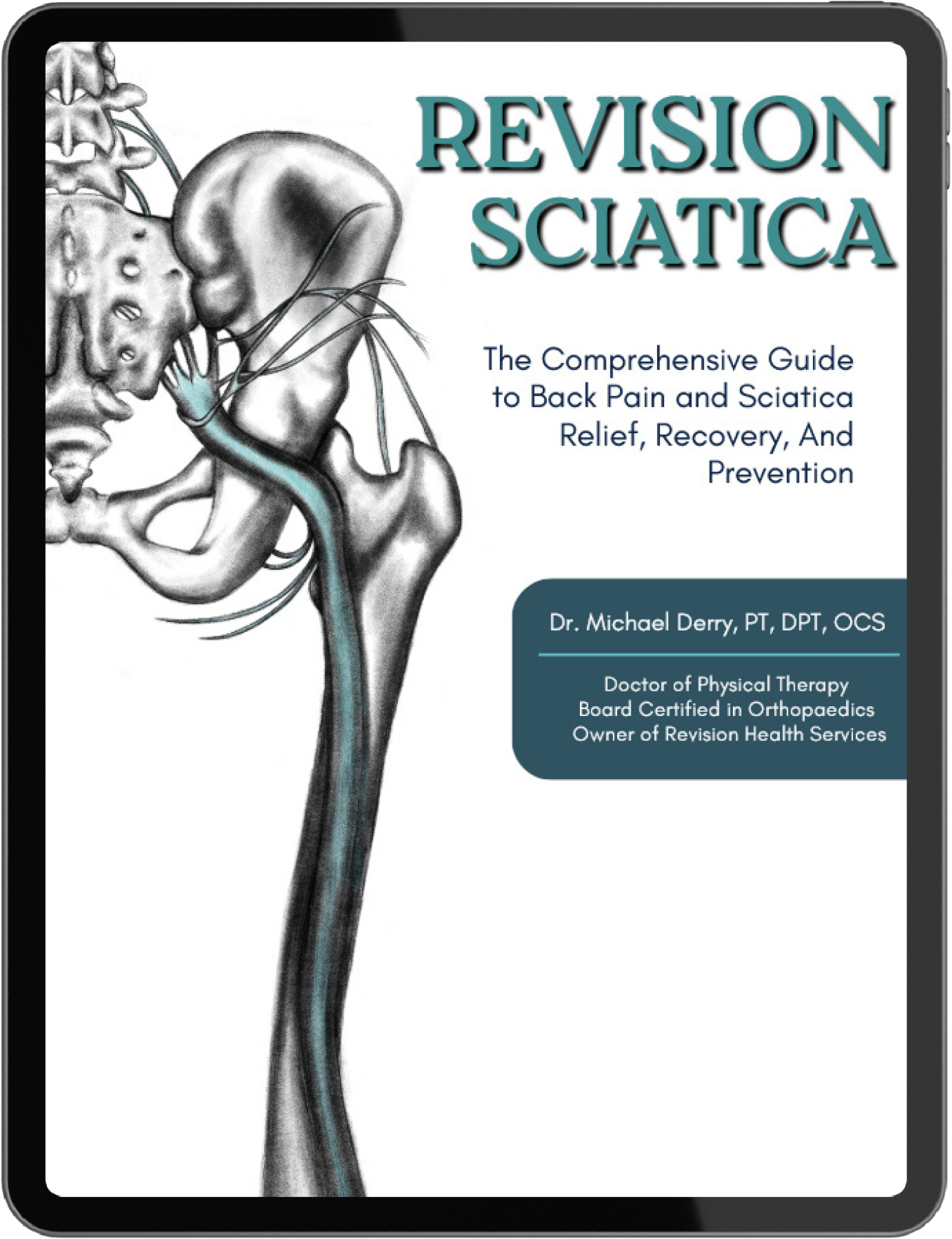
In my experience, patients improve when we focus on improving tissue tolerance—helping your body handle the movement of walking—rather than obsessing over the image on the screen. This is what I lay out in my book, Revision Sciatica. Exactly, how to improve strength, mobility, and nerve health with a step by step system: the SPARK method.

Leveling Up: How to Walk Further
Once you’ve mastered the stretch, consistency is your best friend. I have seen this work when we do this every single day before a walk. By preparing the nerves and "opening the door" before you step out, you increase the distance you can travel before the heaviness sets in. To build further resiliency, you may want to check out my Stenosis exercise video below for a well rounded program. I also created this Pain Free Walking Program specifically for improving walking when you have spinal stenosis.
Frequently Asked Questions About Walking with Stenosis
Can I do this stretch if I have had a knee replacement?
Yes, absolutely. If you cannot bend your knee to 90 degrees that is okay.
Why do I need to do it right before walking?
Stenosis symptoms are often triggered by lack of blood flow from extension of the spine. Doing this active stretch immediately before walking acts as a "warm-up" for your nerves and joints, giving them the best possible environment to handle the stress of walking.
Is it okay if my back pops?
Generally, yes. As long as the pop is not accompanied by sharp pain, it is likely just gas escaping the joint capsule as you move through your range of motion.
How to Take Your Recovery Further
If you’re tired of leaning on shopping carts just to get through the grocery store, I’ve built resources specifically for your journey:
Free Resource: Take my Stenosis Pain & Walking Quiz to see if your walking pain is coming from stenosis.
The Blueprint to walking My Pain-Free Walking Ebook is the exact plan I use with my private patients to reclaim their ability to walk pain free. Stretching and strengthening exercises to improve your walking.
The Sciatica Guide: If you have stenosis with or without leg pain then my book Revision Sciatica Book (released July 2025) covers the "SPARK" method for nerve recovery, back mobility, and strengthening that takes you from step 1 to a great understanding of your body and exactly what to do to improve it that is designed specifically for people like you.
Summary
Walking with stenosis doesn't have to be a battle against your own body. By using this standing stretch to "open" your spinal canal before your walk, you are giving your nerves the space and blood flow they need to thrive. Remember, you are more than an image on an MRI; you are capable of improving your movement and your life. If you're ready for a structured plan, download the Pain-Free Walking Ebook today and let's get you back on the move.
The most effective stretch I have found to improve walking with spinal stenosis is the Standing Hip Flexor-Hamstring Stretch. By alternating between extending the hip and flexing the spine using a chair, you open up the spinal canal and restore blood flow to compressed nerves. This simple movement helps reduce "neurogenic claudication" (heaviness and pain) without requiring you to get on the floor.
The Hip Flexor-Hamstring Stretch
This exercise works because it attacks the problem from two angles: it stretches the tight hip muscles that force your back into a painful arch and are required for walking, and it opens the spine to relieve nerve pressure. Bingo! Here's a video that reviews it!
You don’t need any fancy equipment. All you need is a chair with a back.
- Safety First: Make sure the chair is sturdy.
- Position: Stand facing the chair and have the back of it within reaching distance so you have something to hold onto for balance.
Part 1: The Hip Flexor Stretch
- Place one foot up on the chair. Your knee should be bent at roughly a 90-degree angle.
- Keep your other foot (the stance leg) behind you. It is okay if your heel comes off the ground.
- Stand tall.
- The Movement: Shift your weight forward just until you feel a gentle stretch in the front of the hip of the leg that is on the ground.
- The Hold: Hold for only 1-3 seconds, then back off.
Part 2: The Hamstring Stretch
- From the forward position, shift your weight backward.
- Straighten the front leg (the one on the chair) and lean your chest forward slightly.
- The Movement: As you lean forward, think about rounding your back slightly. Flexion is your friend! This opens the spine while stretching the hamstring.
- The Hold: Hold for 1-3 seconds, then shift forward again.
Reps and Sets I recommend doing 10- 20 repetitions (rocking forward and backward counts as one rep) on each leg immediately before you go for a walk.
Expert Tip: "Motion is lotion." Keep this moving rhythmically. We are trying to pump blood flow to the nerves and gently mobilize joints.
What You Should and Should NOT Feel During the Stretch
When performing this stretch, the golden rule is simple: You cannot have any back pain or leg pain. It should be pain-free!
You should only feel a stretch.
- Correct Feeling: A pulling sensation in the front of the hip and the back of the thigh.
- Incorrect Feeling: Sharp pain in the back.
If you feel a pinch in your back, you are likely pushing the stretch too much. I have had patients do this. Less is more sometimes!
Why Does Walking Hurt with Spinal Stenosis?
Walking is fundamentally an extension exercise. When you stand tall and step back, your lower back arches or extends, which narrows the spaces in your spine. If you have stenosis, it can close down your nerves. While a necessary and safe movement of your spine, it can be painful when you walk. Pain is often felt during walking and may worsen as you continue to stand or walk. Until you start improving your nerves and spine, which I cover in my book!
Stenosis and Arthritis are just "Wrinkles on the inside."
I tell my patients all the time: what they see on images like arthritis or stenosis is often just "wrinkles on the inside." Just as we expect to see wrinkles on our skin as we age, we expect to see changes in our spine. These are structural "wrinkles," and they often don’t cause pain. But sometimes they do! It really depends.
Functional vs. Structural Spinal Stenosis
It’s worth remembering that you are not your MRI. A "structural" narrowing on a scan doesn't always equal "functional" pain.
It’s very common to be told you have stenosis on an image but no pain from it. An image is only one small piece of diagnosis. When my patients have pain from stenosis, that’s functional stenosis. We diagnose this with testing, walking, and more. It’s a clinical diagnosis in that it requires a clinical exam.
Side Note: If someone says you have stenosis and they don’t test you, get a 2nd opinion!
In my experience, patients improve when we focus on improving tissue tolerance—helping your body handle the movement of walking—rather than obsessing over the image on the screen. This is what I lay out in my book, Revision Sciatica. Exactly, how to improve strength, mobility, and nerve health with a step by step system: the SPARK method.
Leveling Up: How to Walk Further
Once you’ve mastered the stretch, consistency is your best friend. I have seen this work when we do this every single day before a walk. By preparing the nerves and "opening the door" before you step out, you increase the distance you can travel before the heaviness sets in. To build further resiliency, you may want to check out my Stenosis exercise video below for a well rounded program. I also created this Pain Free Walking Program specifically for improving walking when you have spinal stenosis.
Frequently Asked Questions About Walking with Stenosis
Can I do this stretch if I have had a knee replacement?
Yes, absolutely. If you cannot bend your knee to 90 degrees that is okay.
Why do I need to do it right before walking?
Stenosis symptoms are often triggered by lack of blood flow from extension of the spine. Doing this active stretch immediately before walking acts as a "warm-up" for your nerves and joints, giving them the best possible environment to handle the stress of walking.
Is it okay if my back pops?
Generally, yes. As long as the pop is not accompanied by sharp pain, it is likely just gas escaping the joint capsule as you move through your range of motion.
How to Take Your Recovery Further
If you’re tired of leaning on shopping carts just to get through the grocery store, I’ve built resources specifically for your journey:
Free Resource: Take my Stenosis Pain & Walking Quiz to see if your walking pain is coming from stenosis.
The Blueprint to walking My Pain-Free Walking Ebook is the exact plan I use with my private patients to reclaim their ability to walk pain free. Stretching and strengthening exercises to improve your walking.
The Sciatica Guide: If you have stenosis with or without leg pain then my book Revision Sciatica Book (released July 2025) covers the "SPARK" method for nerve recovery, back mobility, and strengthening that takes you from step 1 to a great understanding of your body and exactly what to do to improve it that is designed specifically for people like you.
Summary
Walking with stenosis doesn't have to be a battle against your own body. By using this standing stretch to "open" your spinal canal before your walk, you are giving your nerves the space and blood flow they need to thrive. Remember, you are more than an image on an MRI; you are capable of improving your movement and your life. If you're ready for a structured plan, download the Pain-Free Walking Ebook today and let's get you back on the move.

%20Blog%20thumbnails.jpg)


