.jpg)



.jpg)
Best Core Exercises Post Microdiscectomy (& Which to Avoid)


The most effective core exercises after a microdiscectomy prioritize spinal stability and decompression over high-compression movements such as standard planks. In my practice, I recommend the Dead Bug, Single-Leg Glute Bridge, and Prone Swiss Ball Traction. These exercises act as an "internal brace" for your spine. Avoid high-load bending or twisting early on, and immediately stop any exercise that causes nerve pain to travel down your leg.
3 Best Core Exercises After Microdiscectomy
When I work with my clients, we prioritize "anti-movement" exercises. We want the core to keep the spine stable, not to force it into bending or compressing.- which may irritate nerves.
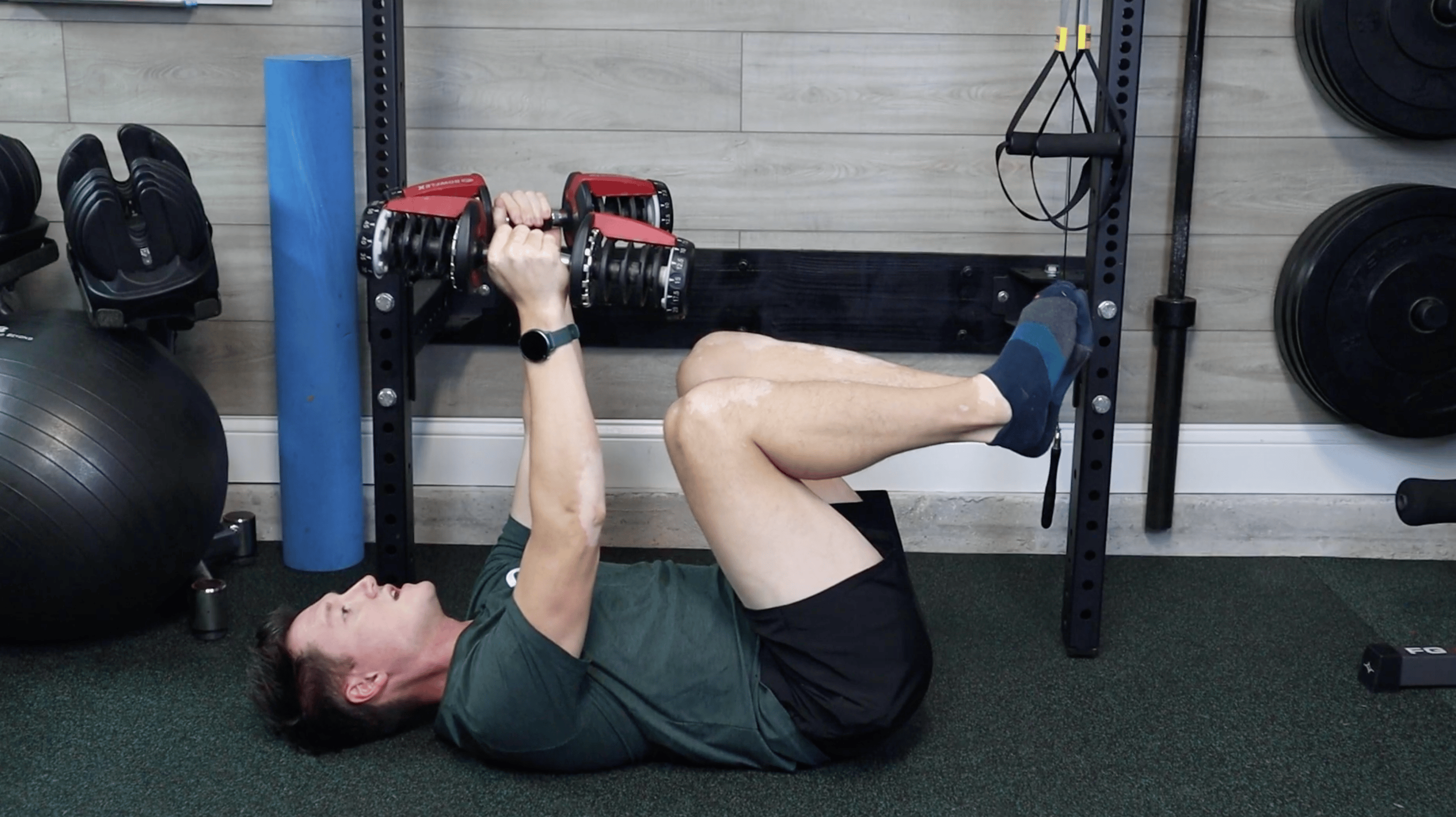
1. The Dead Bug
This is a core staple because it teaches your brain to move your limbs while your spine stays rock-solid.
- How to do it: Lie on your back on a firm surface. Flatten the small of your back against the floor—the opposite of arching. Lift your arms and legs slowly toward the ceiling while keeping your back flat. Perform the Dead Bug motion by extending the right leg as the left arm goes back, then alternating to the left leg and right arm.
- Dosage: 3–4 sets of 10 repetitions, 4x per week.

2. Prone Swiss Ball Traction (The "Plank" Alternative)
For 2026, I recommend replacing the traditional floor plank with Prone Swiss Ball Traction. Planks can often cause the hips to sag, which creates structural pressure on the healing surgical site. Traction achieves stability while decompressing the spine.
- How to do it: Lie face down with your stomach draped over a large Swiss ball. (Which you can find here) Let your feet and hands lightly touch the floor. Gently walk your hands forward until you feel a light, decompressing stretch in your lower back.
- Goal: This creates space for the healing nerves while relaxing your depep stabilizers.
- Dosage: Hold for 30–60 seconds, 3 times
3. Single-Leg Glute Bridge With Band
Your glutes are a major part of your core. If they are weak, your lower back has to do double the work to support you.
- How to do it: Lie on your back, knees bent, put a band at your thighs. Drive through your heels to lift your hips until you are in a straight line from knees to shoulders. Squeeze your glutes at the top.
- Dosage: 2 sets of 12–15 repetitions.


Not sure if your pain is coming from a disc or a bone issue? Take my Sciatica Quiz to help figure it out.
Nerve Health After Surgery: More Than Just Working On Muscle
You likely had pressure on your nerves before surgery. Nerve health comes from movement, specifically, gentle nerve glides or neurodynamics. These help the nerve "slide" smoothly through the surrounding tissue as you heal. This video reviews the sciatica nerve and how to glide it correctly.
Exercises to Avoid After Microdiscectomy(The Non-Negotiables)
In the first 6–8 weeks, avoid movements that put high pressure on the disc or move you into extreme ranges.
- Avoid: Crunches, heavy leg lifts, or full "cat-cow" arches that move the spine aggressively.
- The Golden Rule: If a movement causes peripheralization (pain traveling down your leg), stop immediately. We only want centralization, where pain moves up toward the spine.
Walking: Your First Core Workout After Back Surgery
Walking is essential for aerobic recovery and blood flow to the surgical site.
- The Protocol: I advise patients to get up every 30 minutes for a 5-minute walk. Aim for a total of 15 minutes of continuous walking by the end of week one.
Why "Internal Bracing" is Better Than a Back Brace
Many patients are eager to rely on external back braces after surgery. While they offer temporary pressure, they can actually lead to "lazy" muscles. In my experience, it is far better to strengthen your core to act as your own internal brace.
By improving the strength of the muscles supporting your spine, you increase your tissue tolerance—your body’s ability to handle the "load" of daily life without pain. Remember, you are not your MRI. Even if your images show "wrinkles on the inside"—the natural changes we all get with age—your focus now is on how you move and feel.
A step-by-step recovery plan for your type of sciatica.
Identify your type: disc vs. stenosis - and then follow the 5-phase SPARK protocol. Optional $24 video-course add-on.
by Dr. Michael Derry, PT, DPT, OCS
Expert Perspective, Clinical Insights, and Free Resources
"Real healing doesn't happen to you. It happens because of you." In my experience, the patients who succeed are those who learn to listen to their bodies and respond with the right level of movement.
- Free Resource: Take the FREE Sciatica Quiz to see if sciatica is sitll holding you back
- Get the Full Blueprint: For a complete guide to long-term recovery, check out my Revision Sciatica Book which will give you 8 weeks of exercise, strethces, and nerve movements to return the health of your nerves without making things worse.
- Here are my exericse PDFs Before And After Back Surgery Exercises | PDF - Revision Health Services and Upper Body Strengthening After Back Surgery PDF
Summary
After a microdiscectomy, the most effective core exercises focus on spinal stability and decompression rather than high-compression movements, using exercises like the Dead Bug, Single-Leg Glute Bridge, and Prone Swiss Ball Traction to create an “internal brace.” Strengthening your core from within is more beneficial than relying on external back braces, as it improves your body’s ability to handle daily movement without pain. Early recovery should avoid high-load bending or twisting, prioritize gentle movement like walking, and stop any exercise that causes nerve pain to travel down the leg.
The most effective core exercises after a microdiscectomy prioritize spinal stability and decompression over high-compression movements such as standard planks. In my practice, I recommend the Dead Bug, Single-Leg Glute Bridge, and Prone Swiss Ball Traction. These exercises act as an "internal brace" for your spine. Avoid high-load bending or twisting early on, and immediately stop any exercise that causes nerve pain to travel down your leg.
3 Best Core Exercises After Microdiscectomy
When I work with my clients, we prioritize "anti-movement" exercises. We want the core to keep the spine stable, not to force it into bending or compressing.- which may irritate nerves.
1. The Dead Bug
This is a core staple because it teaches your brain to move your limbs while your spine stays rock-solid.
- How to do it: Lie on your back on a firm surface. Flatten the small of your back against the floor—the opposite of arching. Lift your arms and legs slowly toward the ceiling while keeping your back flat. Perform the Dead Bug motion by extending the right leg as the left arm goes back, then alternating to the left leg and right arm.
- Dosage: 3–4 sets of 10 repetitions, 4x per week.
2. Prone Swiss Ball Traction (The "Plank" Alternative)
For 2026, I recommend replacing the traditional floor plank with Prone Swiss Ball Traction. Planks can often cause the hips to sag, which creates structural pressure on the healing surgical site. Traction achieves stability while decompressing the spine.
- How to do it: Lie face down with your stomach draped over a large Swiss ball. (Which you can find here) Let your feet and hands lightly touch the floor. Gently walk your hands forward until you feel a light, decompressing stretch in your lower back.
- Goal: This creates space for the healing nerves while relaxing your depep stabilizers.
- Dosage: Hold for 30–60 seconds, 3 times
3. Single-Leg Glute Bridge With Band
Your glutes are a major part of your core. If they are weak, your lower back has to do double the work to support you.
- How to do it: Lie on your back, knees bent, put a band at your thighs. Drive through your heels to lift your hips until you are in a straight line from knees to shoulders. Squeeze your glutes at the top.
- Dosage: 2 sets of 12–15 repetitions.
Not sure if your pain is coming from a disc or a bone issue? Take my Sciatica Quiz to help figure it out.
Nerve Health After Surgery: More Than Just Working On Muscle
You likely had pressure on your nerves before surgery. Nerve health comes from movement, specifically, gentle nerve glides or neurodynamics. These help the nerve "slide" smoothly through the surrounding tissue as you heal. This video reviews the sciatica nerve and how to glide it correctly.
Exercises to Avoid After Microdiscectomy(The Non-Negotiables)
In the first 6–8 weeks, avoid movements that put high pressure on the disc or move you into extreme ranges.
- Avoid: Crunches, heavy leg lifts, or full "cat-cow" arches that move the spine aggressively.
- The Golden Rule: If a movement causes peripheralization (pain traveling down your leg), stop immediately. We only want centralization, where pain moves up toward the spine.
Walking: Your First Core Workout After Back Surgery
Walking is essential for aerobic recovery and blood flow to the surgical site.
- The Protocol: I advise patients to get up every 30 minutes for a 5-minute walk. Aim for a total of 15 minutes of continuous walking by the end of week one.
Why "Internal Bracing" is Better Than a Back Brace
Many patients are eager to rely on external back braces after surgery. While they offer temporary pressure, they can actually lead to "lazy" muscles. In my experience, it is far better to strengthen your core to act as your own internal brace.
By improving the strength of the muscles supporting your spine, you increase your tissue tolerance—your body’s ability to handle the "load" of daily life without pain. Remember, you are not your MRI. Even if your images show "wrinkles on the inside"—the natural changes we all get with age—your focus now is on how you move and feel.
A step-by-step recovery plan for your type of sciatica.
Identify your type: disc vs. stenosis - and then follow the 5-phase SPARK protocol. Optional $24 video-course add-on.
by Dr. Michael Derry, PT, DPT, OCS
Expert Perspective, Clinical Insights, and Free Resources
"Real healing doesn't happen to you. It happens because of you." In my experience, the patients who succeed are those who learn to listen to their bodies and respond with the right level of movement.
- Free Resource: Take the FREE Sciatica Quiz to see if sciatica is sitll holding you back
- Get the Full Blueprint: For a complete guide to long-term recovery, check out my Revision Sciatica Book which will give you 8 weeks of exercise, strethces, and nerve movements to return the health of your nerves without making things worse.
- Here are my exericse PDFs Before And After Back Surgery Exercises | PDF - Revision Health Services and Upper Body Strengthening After Back Surgery PDF
Summary
After a microdiscectomy, the most effective core exercises focus on spinal stability and decompression rather than high-compression movements, using exercises like the Dead Bug, Single-Leg Glute Bridge, and Prone Swiss Ball Traction to create an “internal brace.” Strengthening your core from within is more beneficial than relying on external back braces, as it improves your body’s ability to handle daily movement without pain. Early recovery should avoid high-load bending or twisting, prioritize gentle movement like walking, and stop any exercise that causes nerve pain to travel down the leg.

%20Blog%20thumbnails.jpg)


