


Symptoms of Spinal Stenosis: Understanding Pain and What it Takes to Feel Better


If you’ve recently received an MRI report mentioning "narrowing" or "stenosis," or have been told you have stenosis, it’s common to feel a little uneasy. But here is the truth I tell every patient I see: You are not your MRI!
When I work with my clients, I often describe these findings as "wrinkles on the inside." Just as we expect to see wrinkles on our skin as we age, we expect to see changes in our spine. Sometimes these structural changes cause pain, and sometimes they don't.
Stenosis is unique in that we should focus on what you feel vs. what we see.
Once you start doing that and learning your symptoms, your recovery will happen so much faster.
Let’s explore common symptoms and what I have seen help many of my clients become pain-free.
Common Symptoms of Lumbar Spinal Stenosis
Spinal stenosis is essentially a narrowing of the spaces within your spine, which often puts pressure on the nerves. This can happen in the center of the spine (central) or off to the side (foraminal). This can often cause sciatica. However, the presence of narrowing doesn't always equal pain. In my experience, I have seen patients with "severe" imaging who walk miles without issue, and others with "mild" imaging who struggle to reach the mailbox. You really never know.
The Hallmark Signs and Symptoms of Spinal Stenosis
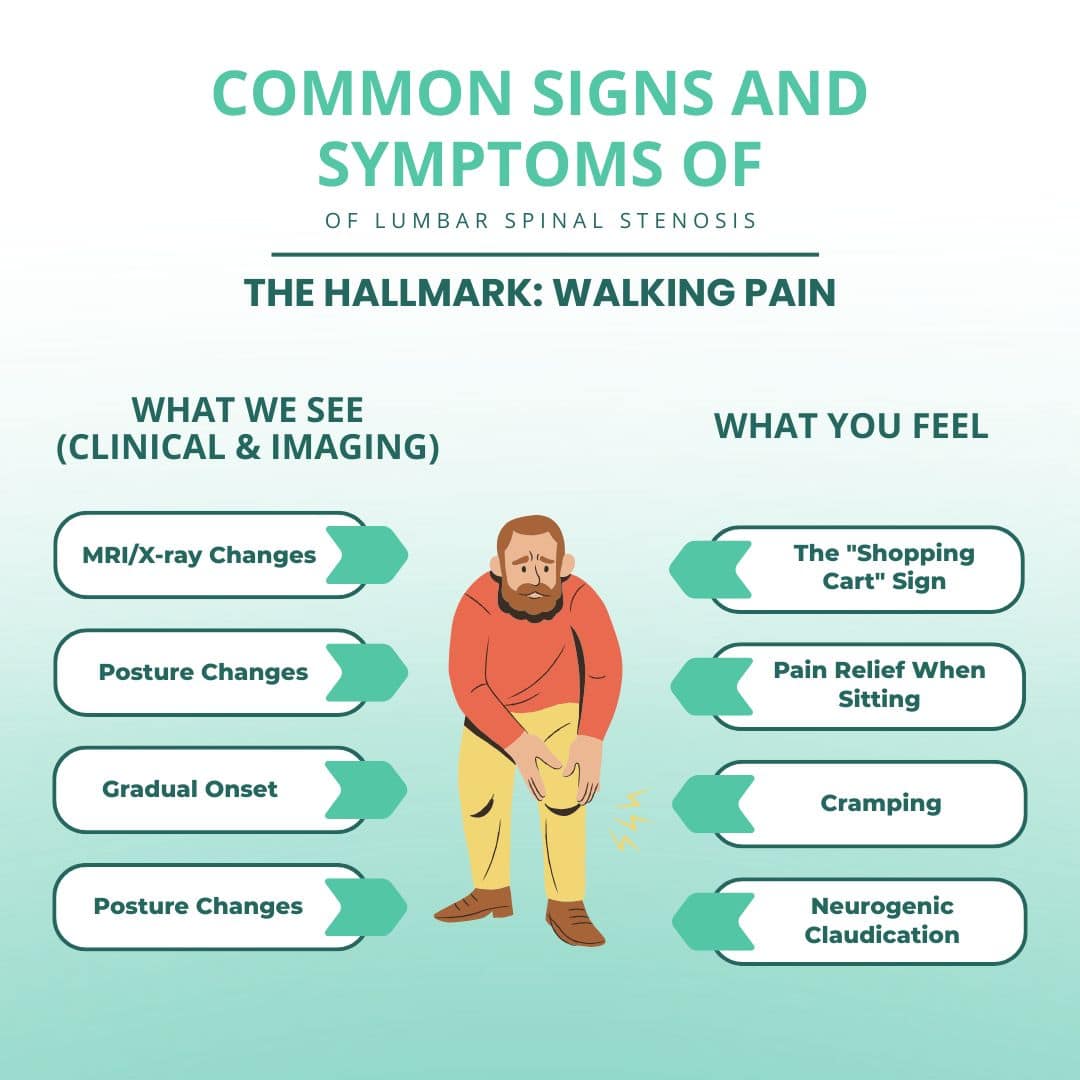
If you truly have lumbar spinal stenosis, you need the mindset of working smarter, not harder. You have to get to know your body and learn exactly what you are feeling. Let’s break this down into "Signs" (what we see) and "Symptoms" (what you feel).
The hallmark is pain with walking. That can be back pain, hip pain or leg pain.
Signs: What We See (Your Body & Imaging)
- MRI/X-ray Changes: Evidence of arthritis, disc bulges, spondylosis, or spondylolisthesis. - to name a few!
- Posture Changes: A tendency to hunch forward to find relief.
- Gradual Onset: Pain that has slowly increased over the years.
Symptoms: What YOU Feel
- The Shopping Cart is Your Friend: Finding that you can walk much further if you are leaning over a cart at the grocery store.
- Pain Relief When Sitting: Immediate relief the moment you sit down or lean forward.
- Cramping: Especially after being on your feet for an extended period.
- Neurogenic Claudication: A progressive increase in pain or tingling as you walk, which "resets" when you sit.
Free Resource: If you aren't sure whether your walking pain is stenosis, take this free Stenosis Quiz to find out.
Leg Pain and Spinal Stenosis
One of the most frequent complaints I hear is spinal stenosis leg pain or nerve pain. Unlike a muscle strain, this pain follows a specific pattern. It can be bilateral (both sides), but often just one leg. This is typically neurogenic claudication. - Explianed below
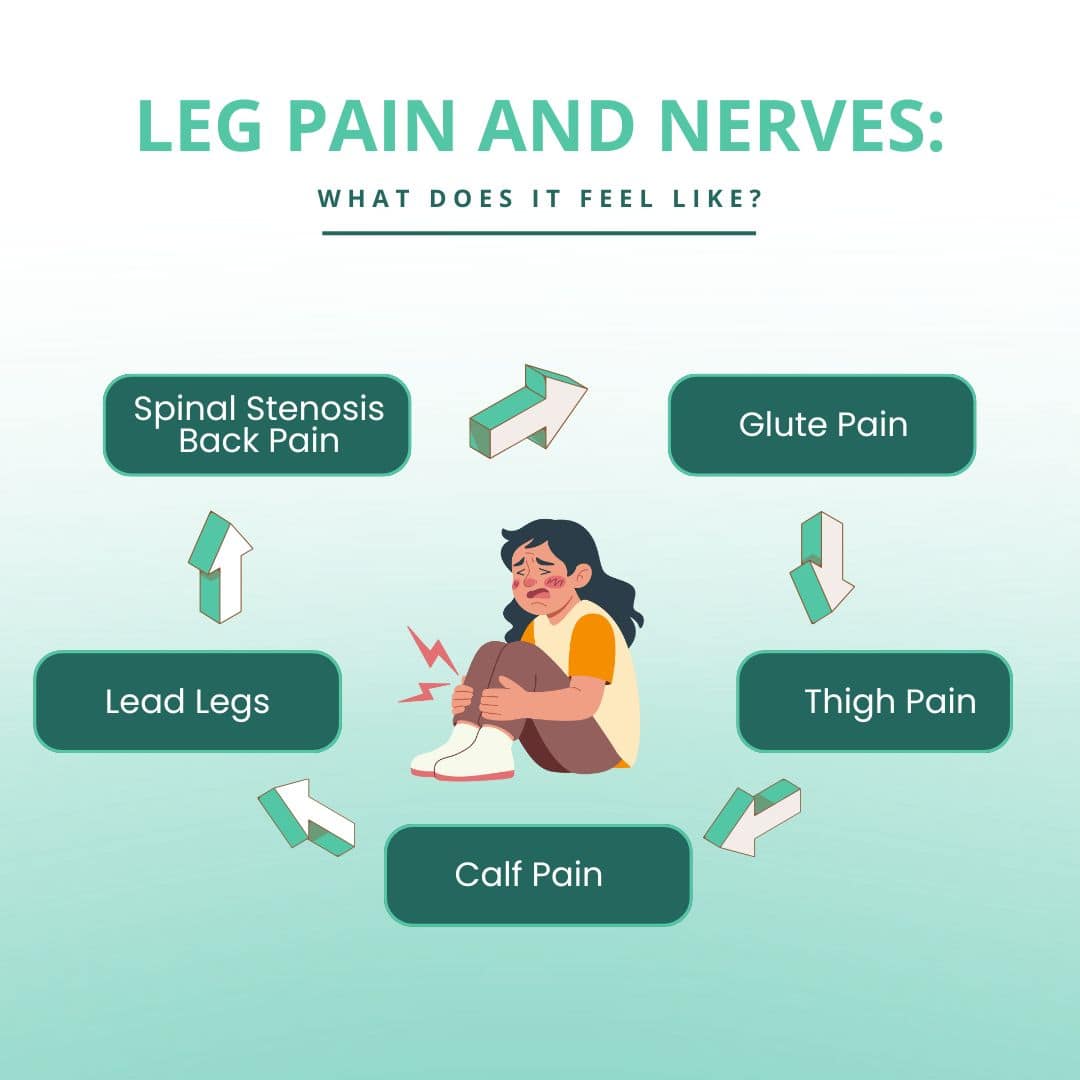
- Spinal Stenosis Back Pain: Since the changes and arthritis are in your back, pain is often felt in the small of your back and travels down.
- Glute Pain: Your back joints and nerves refer pain into the glutes. You may feel like you want to stretch your butt muscles, but it's actually your back "talking" to your glute.
- Thigh Pain: Often felt in the back or sides of the thighs during walking. Most often, there is nothing "wrong" with your leg muscles; they are just responding to nerve irritation.
- Calf Pain: Frequently mistaken for circulation issues, but often it’s the nerves being compressed in your back.
- "Lead Legs": Many of my patients describe a heavy sensation, as if they are walking through water or have weights strapped to their ankles.
Numbness, Tingling, and Weakness From Stenosis
As the space for the nerves decreases, the electrical signals to your feet can get "fuzzy." This happens in some and not others. It's very variable.
- Numbness in Feet: Feeling like your foot is "asleep" or like you are walking on cotton balls.
- Leg Weakness: Noticing your toe catching on the carpet or weakness when climbing stairs.
Neurogenic Claudication Explained
If you feel pain, numbness, or weakness that only happens when you walk or stand and goes away almost immediately when you sit, you are likely experiencing neurogenic claudication.
When you stand and walk, the space for your nerves (often at L4-L5 and L5-S1) reduces, which limits blood flow to the nerves. This causes progressive "traveling" pain. Flexion (sitting or leaning forward) opens the space for the nerves. This is why we focus on flexion-based strengthening and stretching to improve.
Learn more about flexion-focused strength and stretches in my video:
My Perspective: What It Takes to Get Better
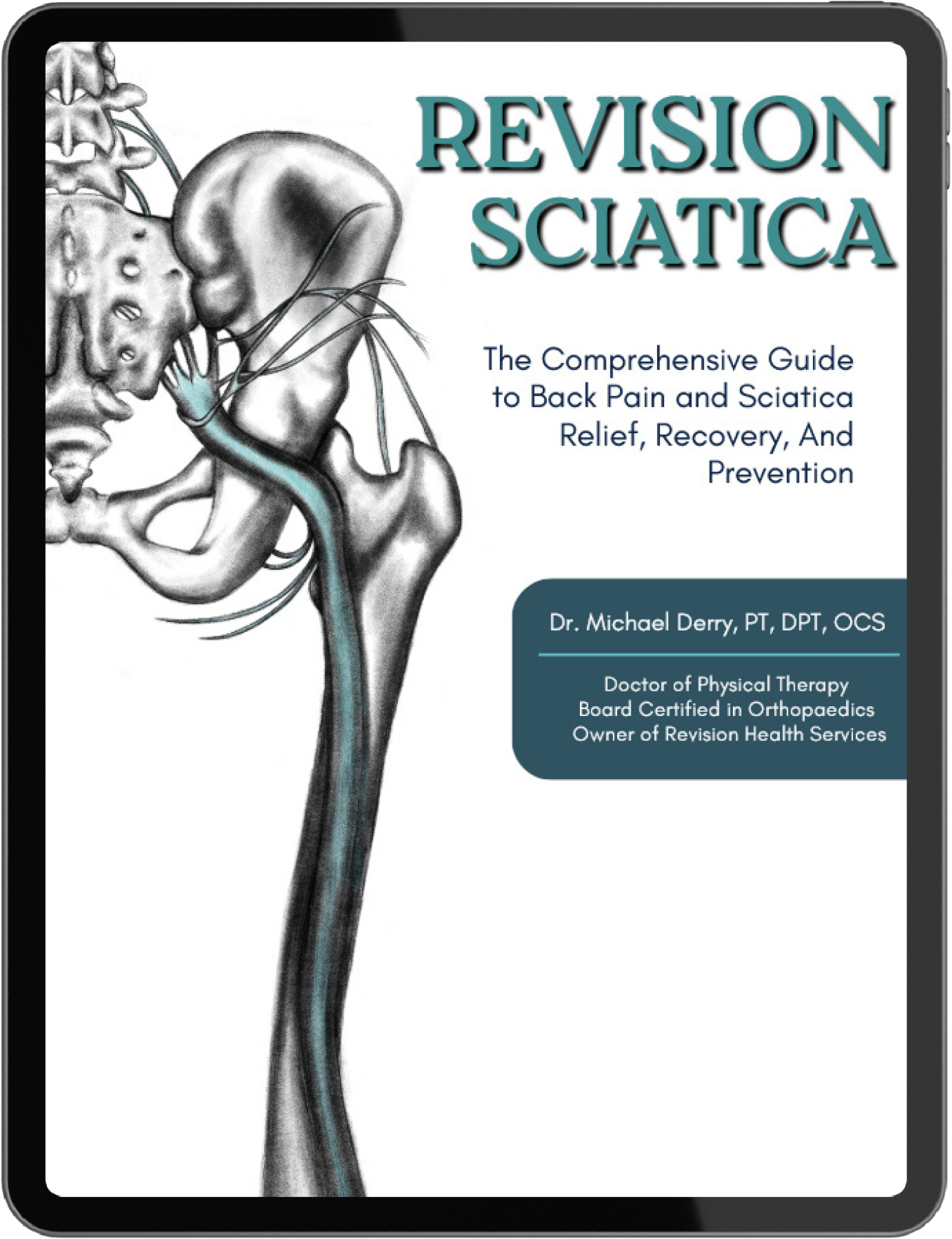
In the Revision Sciatica Book, I discuss how to improve tissue tolerance. We don't "fix the image", we improve how the nerves handles stress.
- Learn Your Body: Discover which movements are painful and which feel good.
- Don’t Focus on the Image: You are more than a picture of your bones.
- Move Safely: Stretch and strengthen, but do it in a way that respects your nerves.
- Improve Nerve Health: Try nerve glides to help the "breathing room" of your nervous system.
"Your spine is a robust, adaptable structure. It is not a delicate stack of blocks that is one wrong move away from collapsing." — Dr. Michael Derry, PT
When Symptoms Are Serious (Cauda Equina)
While conservative care works for the majority, you must watch for "Red Flags" that prompt medical intervention. Seek immediate help for:
- Progressive muscle strength loss in your legs
- Loss of bowel or bladder function.
- Groin/Saddle numbness.
- Paralysis in one leg.
Ready to start walking without pain? My Pain-Free Walking with Spinal Stenosis Ebook provides the exact step-by-step roadmap I use with my private clients to increase walking distance and reduce leg symptoms safely.
Summary
Understanding your symptoms is the first step toward reclaiming your mobility and avoiding unnecessary surgery. By focusing on functional movement rather than just your MRI results, you can build the "tissue tolerance" needed to walk and stand without that heavy, painful sensation. I have seen countless patients improve their quality of life by simply learning how to give their nerves the space they need to thrive.
If you’ve recently received an MRI report mentioning "narrowing" or "stenosis," or have been told you have stenosis, it’s common to feel a little uneasy. But here is the truth I tell every patient I see: You are not your MRI!
When I work with my clients, I often describe these findings as "wrinkles on the inside." Just as we expect to see wrinkles on our skin as we age, we expect to see changes in our spine. Sometimes these structural changes cause pain, and sometimes they don't.
Stenosis is unique in that we should focus on what you feel vs. what we see.
Once you start doing that and learning your symptoms, your recovery will happen so much faster.
Let’s explore common symptoms and what I have seen help many of my clients become pain-free.
Common Symptoms of Lumbar Spinal Stenosis
Spinal stenosis is essentially a narrowing of the spaces within your spine, which often puts pressure on the nerves. This can happen in the center of the spine (central) or off to the side (foraminal). This can often cause sciatica. However, the presence of narrowing doesn't always equal pain. In my experience, I have seen patients with "severe" imaging who walk miles without issue, and others with "mild" imaging who struggle to reach the mailbox. You really never know.
The Hallmark Signs and Symptoms of Spinal Stenosis
If you truly have lumbar spinal stenosis, you need the mindset of working smarter, not harder. You have to get to know your body and learn exactly what you are feeling. Let’s break this down into "Signs" (what we see) and "Symptoms" (what you feel).
The hallmark is pain with walking. That can be back pain, hip pain or leg pain.
Signs: What We See (Your Body & Imaging)
- MRI/X-ray Changes: Evidence of arthritis, disc bulges, spondylosis, or spondylolisthesis. - to name a few!
- Posture Changes: A tendency to hunch forward to find relief.
- Gradual Onset: Pain that has slowly increased over the years.
Symptoms: What YOU Feel
- The Shopping Cart is Your Friend: Finding that you can walk much further if you are leaning over a cart at the grocery store.
- Pain Relief When Sitting: Immediate relief the moment you sit down or lean forward.
- Cramping: Especially after being on your feet for an extended period.
- Neurogenic Claudication: A progressive increase in pain or tingling as you walk, which "resets" when you sit.
Free Resource: If you aren't sure whether your walking pain is stenosis, take this free Stenosis Quiz to find out.
Leg Pain and Spinal Stenosis
One of the most frequent complaints I hear is spinal stenosis leg pain or nerve pain. Unlike a muscle strain, this pain follows a specific pattern. It can be bilateral (both sides), but often just one leg. This is typically neurogenic claudication. - Explianed below
- Spinal Stenosis Back Pain: Since the changes and arthritis are in your back, pain is often felt in the small of your back and travels down.
- Glute Pain: Your back joints and nerves refer pain into the glutes. You may feel like you want to stretch your butt muscles, but it's actually your back "talking" to your glute.
- Thigh Pain: Often felt in the back or sides of the thighs during walking. Most often, there is nothing "wrong" with your leg muscles; they are just responding to nerve irritation.
- Calf Pain: Frequently mistaken for circulation issues, but often it’s the nerves being compressed in your back.
- "Lead Legs": Many of my patients describe a heavy sensation, as if they are walking through water or have weights strapped to their ankles.
Numbness, Tingling, and Weakness From Stenosis
As the space for the nerves decreases, the electrical signals to your feet can get "fuzzy." This happens in some and not others. It's very variable.
- Numbness in Feet: Feeling like your foot is "asleep" or like you are walking on cotton balls.
- Leg Weakness: Noticing your toe catching on the carpet or weakness when climbing stairs.
Neurogenic Claudication Explained
If you feel pain, numbness, or weakness that only happens when you walk or stand and goes away almost immediately when you sit, you are likely experiencing neurogenic claudication.
When you stand and walk, the space for your nerves (often at L4-L5 and L5-S1) reduces, which limits blood flow to the nerves. This causes progressive "traveling" pain. Flexion (sitting or leaning forward) opens the space for the nerves. This is why we focus on flexion-based strengthening and stretching to improve.
Learn more about flexion-focused strength and stretches in my video:
My Perspective: What It Takes to Get Better
In the Revision Sciatica Book, I discuss how to improve tissue tolerance. We don't "fix the image", we improve how the nerves handles stress.
- Learn Your Body: Discover which movements are painful and which feel good.
- Don’t Focus on the Image: You are more than a picture of your bones.
- Move Safely: Stretch and strengthen, but do it in a way that respects your nerves.
- Improve Nerve Health: Try nerve glides to help the "breathing room" of your nervous system.
"Your spine is a robust, adaptable structure. It is not a delicate stack of blocks that is one wrong move away from collapsing." — Dr. Michael Derry, PT
When Symptoms Are Serious (Cauda Equina)
While conservative care works for the majority, you must watch for "Red Flags" that prompt medical intervention. Seek immediate help for:
- Progressive muscle strength loss in your legs
- Loss of bowel or bladder function.
- Groin/Saddle numbness.
- Paralysis in one leg.
Ready to start walking without pain? My Pain-Free Walking with Spinal Stenosis Ebook provides the exact step-by-step roadmap I use with my private clients to increase walking distance and reduce leg symptoms safely.
Summary
Understanding your symptoms is the first step toward reclaiming your mobility and avoiding unnecessary surgery. By focusing on functional movement rather than just your MRI results, you can build the "tissue tolerance" needed to walk and stand without that heavy, painful sensation. I have seen countless patients improve their quality of life by simply learning how to give their nerves the space they need to thrive.

%20Blog%20thumbnails.jpg)


