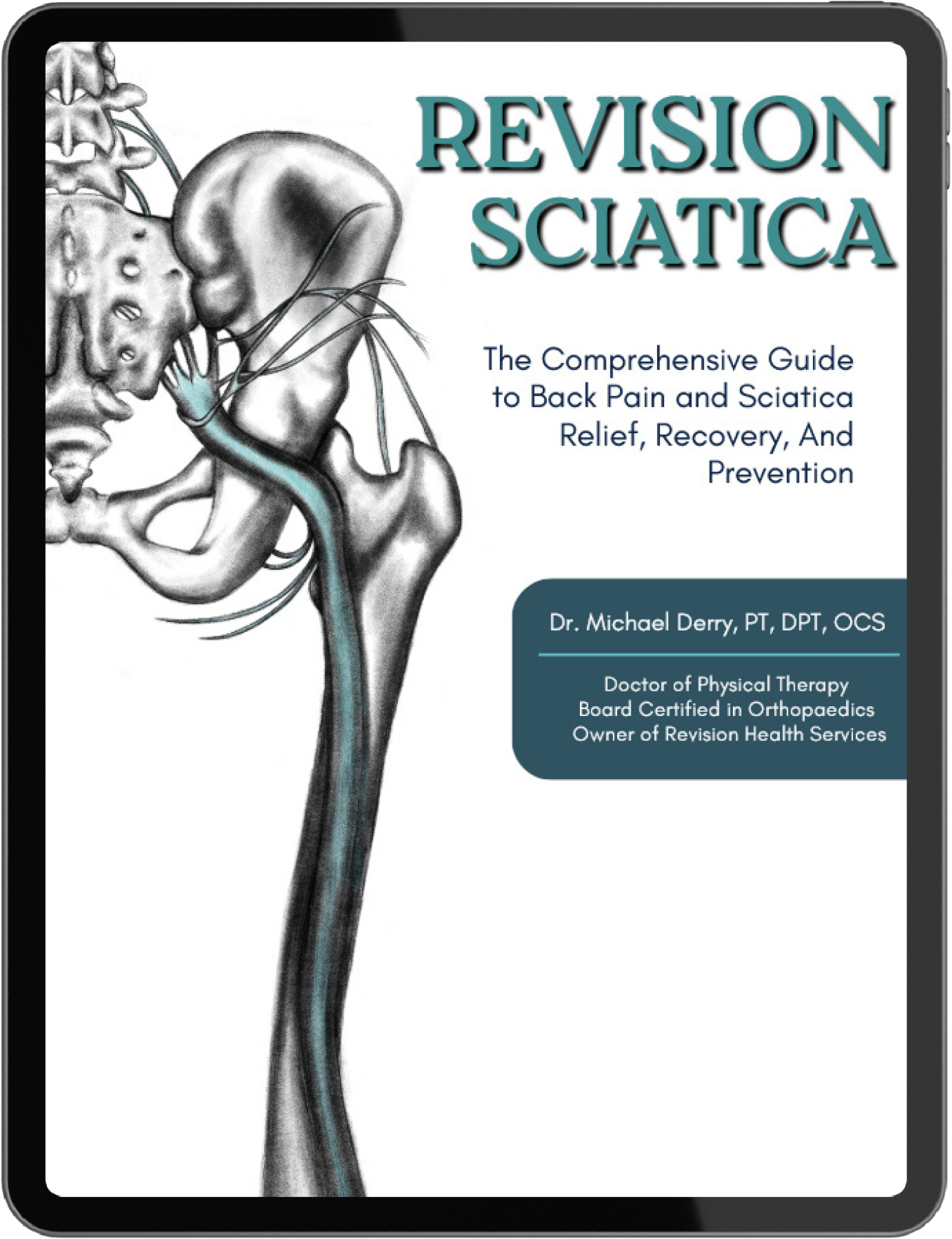
Revision Stenosis · Coming soon

Walk, Stand, and Enjoy Life Without Pain: Improve Your Strength, Mobility, and Nerves When You Have Lumbar Spinal Stenosis

Tired of having to sit so much? Tired of not knowing what to do? Revision Stenosis gives you a complete 200+ page SPARK Program roadmap, with video and photo demonstrations, to open your spine, calm irritated nerves, and avoid surgery.

By Dr. Michael Derry, DPT, author of Revision Sciatica

Get an email when the book is out

Joining is free and doesn’t commit you to buying the book. You can unsubscribe anytime. Privacy policy

In their words

What People Say About the SPARK Program for Spinal Stenosis

A few words from people who have worked through Michael’s SPARK program. Everyone’s path is different, and results vary.

“I’m already finding I can walk way further now than I have in the last year.”
A.C.
“I’ve been very pleased at the progress I’ve made so far, in such a short amount of time. I still have some days where I don’t feel as good as other days but the key here is to keep going.”
M.S.
The plan

The SPARK Program, Built for Stenosis

The heart of the book is SPARK, the framework Michael has built his clients’ stenosis care around. The book lays it out in three phases you move through at your own pace, and every phase works on all five pieces.

  • S: Strengthening

    Building capacity in your hips, spine, and core, starting with positions that take pressure off your nerves.

  • P: Pain Relief

    One or two reliable ways to settle your symptoms, like a favorite stretch or simple traction at home.

  • A: Activating Nerves

    Gentle nerve glides to nourish irritated nerves, a part of recovery Michael says often gets overlooked.

  • R: Regaining Mobility

    Restoring your spine’s range of motion, starting with bending forward and turning, and adding more as you’re ready.

  • K: Keep Moving

    Daily movement you can tolerate, whether that’s walking, biking, or the pool, with breaks allowed.

  1. Phase 1

    Foundation

    Calming things down with pain relief, confidence, and simple habits you can keep.

  2. Phase 2

    Predictability

    Learning the patterns your body responds to, so an exercise doesn’t leave you paying for it the next day.

  3. Phase 3

    Resiliency

    Higher-capacity strengthening for your legs and core, aimed at the future you want.

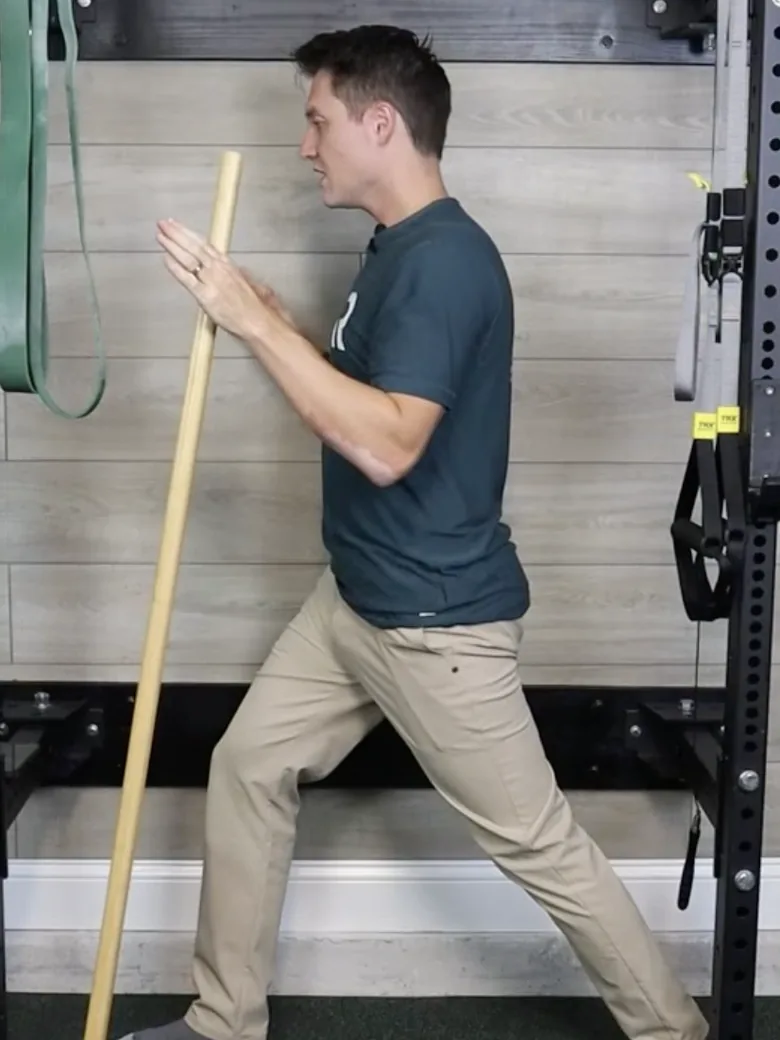
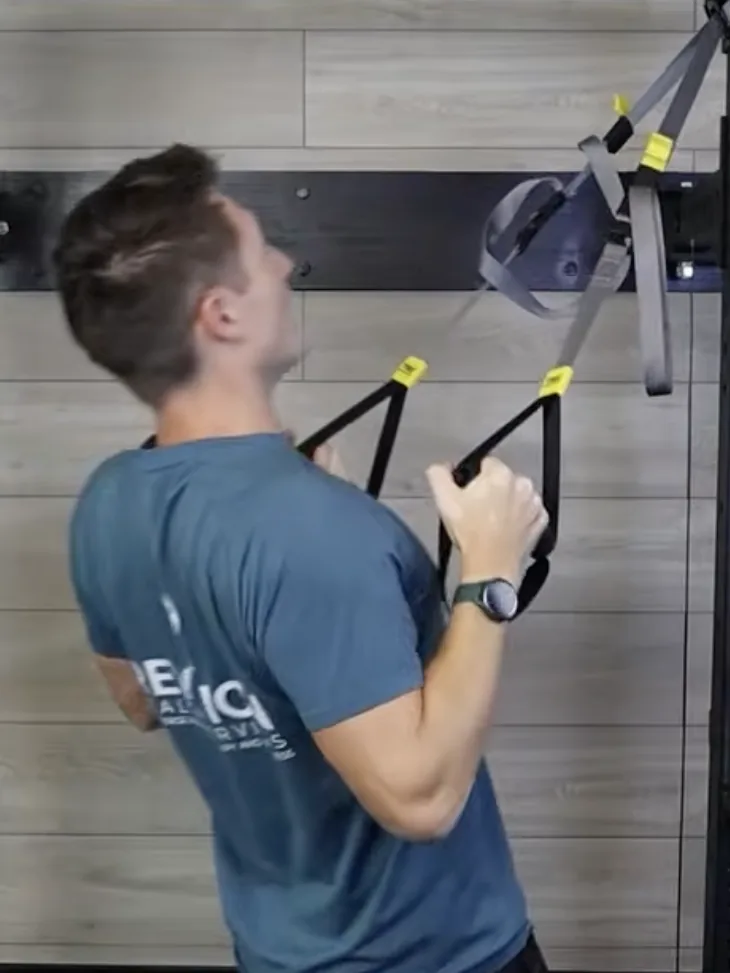
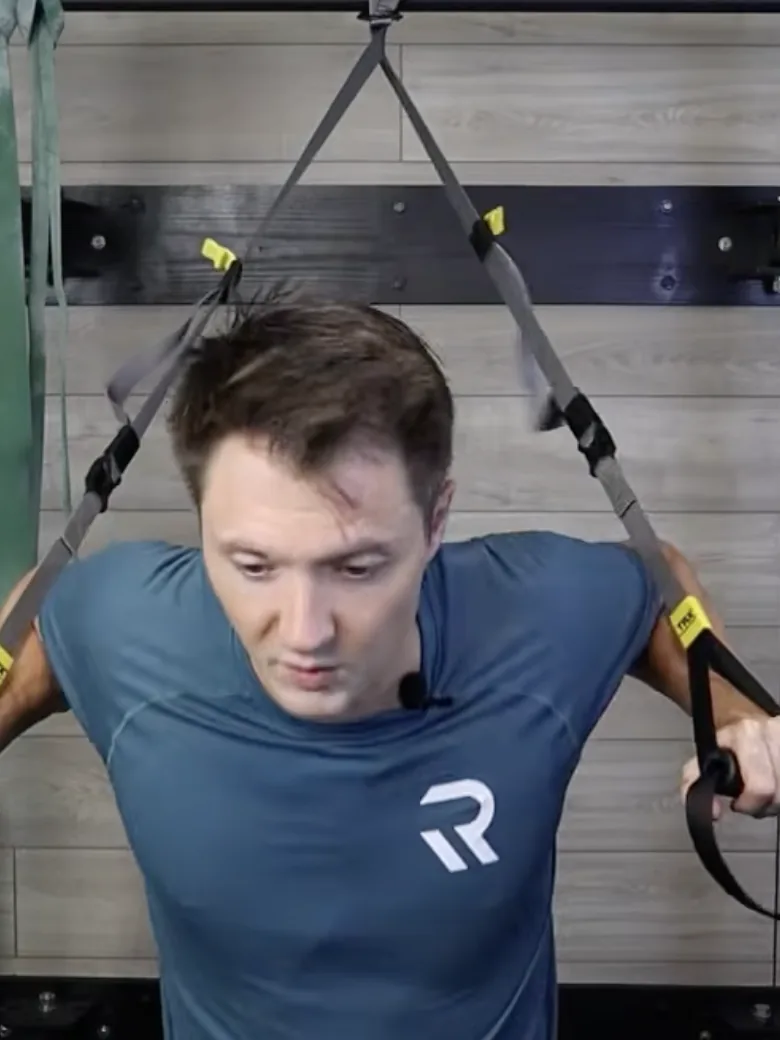
Every Exercise in Revision Stenosis Includes a Photo, Reps, and Sets

You’ll know how each move should look and how much to do before you start. Here are three from the book.

Dr. Michael Derry demonstrating a staggered stance balance hold, one leg stepped back, holding a balance stick for support
Staggered stance balance hold
Dr. Michael Derry demonstrating a suspension trainer row, leaning back and pulling the handles toward his chest
Suspension trainer row
Dr. Michael Derry demonstrating a suspension trainer chest press, leaning forward into the straps
Suspension trainer chest press
The idea behind the book

Why Walking Hurts and Sitting Helps

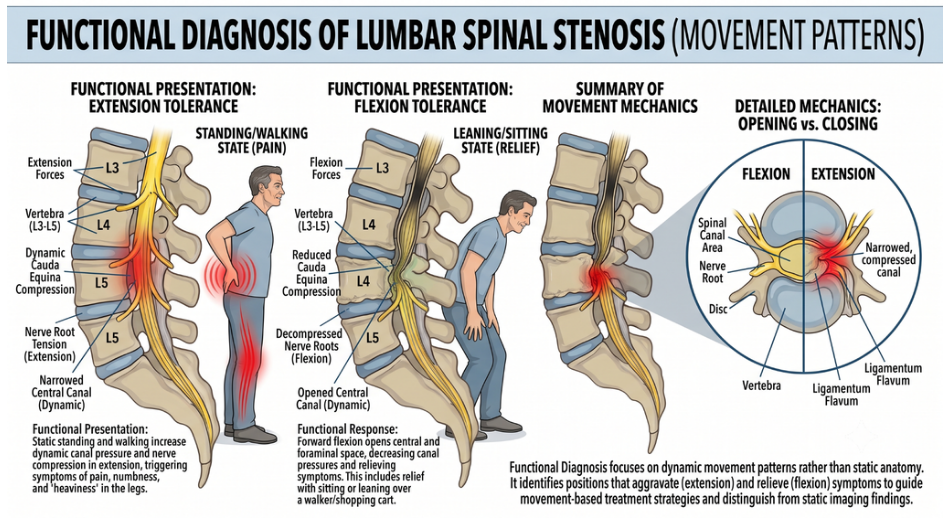
When you stand tall or walk, your lower back arches slightly. With stenosis, that small arch narrows the space around your nerves right when the nerves to your legs need more blood flow. That’s the heaviness, tingling, or burning that builds as you go.

Sitting or leaning forward opens the space back up, which is why the bench and the shopping cart help. Michael calls this the shopping cart sign. Plenty of people feel self-conscious about leaning on the cart, and his advice is to give yourself some grace, because that lean is your body protecting your nerves.

Two ideas from the book build on this pattern and shape the whole plan: stenosis is a space issue, and what you feel matters more than what your MRI shows.

What typically hurts

Leaning back (extension) narrows the space around your nerves.
  • Standing up tall
  • Walking
  • Arching backward
  • Lying flat on your belly
  • Reaching overhead
  • Grocery shopping

What typically helps

Bending forward (flexion) opens that space back up.
  • Sitting down
  • Bending forward
  • Leaning on a shopping cart
The core problem

Stenosis Is a Space Issue

Stenosis simply means there’s less space in your spine for your nerves, either in the central canal or in the openings where the nerves branch out. It usually comes from changes that happen to everyone with time. Discs lose height, the joints wear, and your body lays down bone spurs and thickens a ligament to steady things. Over the years, that extra bone and tissue crowds the nerves.

So the plan starts with the space. Mobility and nerve health come first, and strength builds on top once your nerves are calmer and your spine moves better.

“Stenosis is a space issue. The goal is to maximize that space while building higher tolerance in your tissues and your nerves.”
Dr. Michael Derry, from the book
Progression of spinal stenosis: illustration from the book comparing a normal lumbar segment with structural stenosis, where facet arthritis, lower disc height, bone spurs and a thickened ligament narrow the space and pinch a nerve root
How arthritic changes, like bone spurs and a thickened ligament, narrow the openings a nerve passes through.
Two kinds of diagnosis

Structural vs. Functional Stenosis

There are two ways to look at a stenosis diagnosis: what shows up on your MRI, and what you actually feel. The book focuses on the second, because that’s the one you can change.

Structural stenosis

What the MRI Shows

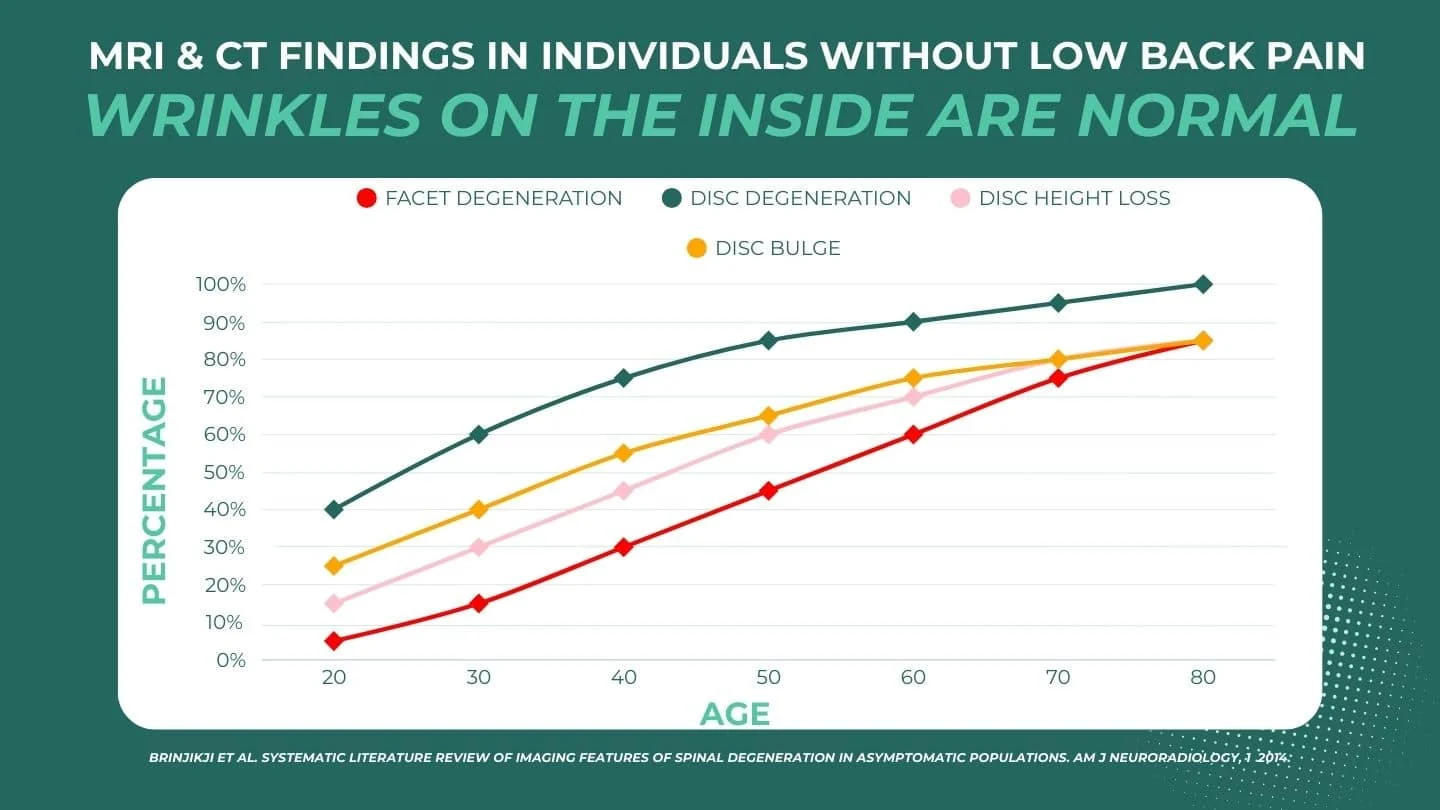
This is the narrowing a doctor sees on an X-ray or MRI, from arthritis, disc changes, or bone spurs. Imaging is very sensitive, so it picks up stenosis in plenty of people who feel fine. Roughly half of people over 65 have it, whether they feel it or not.

MRI and CT findings in people without back pain: chart from the book showing that disc degeneration, disc bulges, disc height loss and facet degeneration all become more common with age in people who have no back pain
Scans find disc and joint changes in most people as they age, including people with no back pain at all (adapted from Brinjikji et al., 2015).
Functional stenosis

What You Feel

This is stenosis that’s actually tied to your symptoms: leg pain, heaviness, or numbness that builds when you stand or walk and eases when you sit or lean forward. Michael has treated people with functional stenosis whose MRIs look rough and others whose MRIs look fairly good.

Functional diagnosis of lumbar spinal stenosis: illustration from the book comparing standing and walking, where the space around the nerves narrows and pain builds in the legs, with leaning forward or sitting, where the space opens and symptoms ease
From the book. Standing and walking narrow the space around the nerves. Leaning forward or sitting opens it back up.

How that shapes treatment. Exercise won’t change what shows up on your scan. It can change how you move and how your nerves respond, and that’s what drives your symptoms. So the book treats what you feel. If you feel stiff, you work on stiffness. If you feel weak, you work on strength. As Michael puts it, people are not their images, and pain and mobility can improve even while the MRI still shows the same changes.

Who it’s for

Does This Sound Like You?

Stenosis shows up differently in everyone, but a few patterns come up again and again in Michael’s practice.

Your walks end sooner than you want them to. You head out feeling fine, then your legs get heavy, tight, or tingly and you start looking for a bench. A few minutes of sitting and you can keep going.

You lean on the shopping cart, and it helps. Grocery shopping is easier bent over a cart, and you find yourself looking for a counter or a railing to lean on.

You can sit through a long car ride without much trouble. Standing at the kitchen counter or waiting in a checkout line is where it gets hard.

Your legs hurt more than your back does. The ache sits in your glute, hamstring, calf, or foot, sometimes with no back pain at all.

Your foot goes numb after you’ve been up for a while. It might tingle or just feel “different” from the other side, and some nights cramps in your calf or foot wake you up.

Your imaging report was hard to make sense of. It used words like degeneration, spondylosis, and narrowing, and said very little about what to do next.

What’s inside

What the Book Covers

When Michael asked his email list what they wanted from a stenosis book, the top answers were non-surgical options and step-by-step exercises with photos. Here’s what Revision Stenosis covers.

Arthritis vs. nerve pain: illustration from the book contrasting arthritic pain, which stays in the lower back and glutes and is worst in the morning, with nerve pain, which follows the sciatic nerve into the leg with or without back pain
Arthritic pain and nerve pain tend to behave differently, and the book walks through how to tell which one you’re dealing with.

Routines for Specific Symptoms

  • A standing and walking protocol, with walking hacks
  • When to keep walking and when to sit
  • A nerve health routine for numbness and tingling
  • Routines for foot drop, night leg cramps, and balance
  • Posture, and getting strong despite stenosis

Making Sense of Your Symptoms

  • Why your MRI and how you feel don’t always match
  • What tends to make stenosis worse, and what tends to ease it
  • How to tell nerve pain from arthritis or muscle pain
  • Stenosis, hip bursitis, or piriformis syndrome?

The SPARK Program

  • Phase-by-phase exercises with photos
  • How to know when you’re ready for the next phase
  • Why symptoms moving back toward your spine are a good sign
  • How to scale each phase if your symptoms flare easily

Other Diagnoses on Your Report

  • Osteoporosis, and how to exercise safely with it
  • Past disc herniations and bulges
  • Degenerative disc disease and spondylosis, in plain terms
  • Degenerative scoliosis

Myths and Treatment Options

  • Does nerve pain mean nerve damage?
  • The wheelchair fear, and why a scan doesn’t decide your future
  • Where traction, stretching, heat, injections, and medication fit in
  • Stem cells and PRP, and why Michael is cautious about them

Navigating Surgery

  • Getting out of the “surgery or do nothing” trap
  • What research shows on decompression and fusion
  • The signs that make surgery worth a serious look
  • Working with your surgeon and physical therapist as a team

Michael is writing it to be highly visual, with photos throughout and QR codes that link to his videos. Chapter names may change before release.

Dr. Michael Derry, Doctor of Physical Therapy
About the author

Meet Dr. Michael Derry

PT, DPT, OCS · Board-Certified Orthopedic Clinical Specialist

Michael is a board-certified orthopedic clinical specialist and the founder of Revision Health Services in Jacksonville, Florida. He earned his Doctor of Physical Therapy at Bradley University, completed an orthopedic residency, and has been a physical therapist for over a decade.

“I have really grown to enjoy treating stenosis,” he writes in the book’s introduction. “The results can be dramatic but the exact pathway to relief is different for everyone. So, I can understand your frustrations to this point.”

He knows the patient side too. At 25, while in physical therapy school, he was dealing with sharp nerve pain down his leg and was offered surgery as his only option. Working through it himself, he developed the approach that became the SPARK method. He’s the author of Revision Sciatica and shares exercise videos on his YouTube channel, The Resilient Spine.

“While I can’t promise total pain relief, I can promise that if you put in the work and listen to your body, your trajectory will change. It won’t be effortless, but you don’t have to do it alone.”

Dr. Michael Derry, from the book

Reviews

Recent Reviews of Michael’s Practice

★★★★★ 5.0 on Google · 70+ reviews of Revision Health Services. A few recent ones, shortened:

★★★★★
“Dr Michael Derry is the best! … I am so grateful to him. I feel happy calm and full of energy again. For all his readers please follow him.”
Dina A. · Google review
★★★★★
“I came to him with a shoulder injury … He was knowledgeable, encouraging, and took the time to explain what was going on and why we were doing each part of my treatment.”
Juli R. · Google review
★★★★★
“My dad had total knee arthroplasty and needed extensive physical therapy. … dad is completely independent, stronger and actually sometime he beats me walking faster.”
D.P. · Google review
★★★★★
“Jeb and Mike … were the best physical therapists that I could have ever hoped for. They were kind, considerate and patient.”
Patricia B. · Google review

Read more reviews on Google (opens in a new tab) →

Questions

Questions About the Waitlist

Michael is finishing the manuscript now, and there’s no release date to share yet. Join the waitlist and we’ll email you when it’s available.

No. Joining is free and doesn’t commit you to anything. You’ll get an email when the book is out, and you can unsubscribe at any time.

It can be. There’s a full section on navigating surgery: what the research shows about decompression and fusion, the signs that make surgery worth a serious look (like leg weakness that keeps getting worse), and why getting stronger beforehand is worth it on either path. Michael usually tells his patients to keep their appointments with their doctor or surgeon. The book is educational and isn’t a substitute for their advice, but it can help you go into those conversations with better questions.

Revision Sciatica covers sciatica from both disc herniations and stenosis. Revision Stenosis is about lumbar stenosis alone, so it goes deeper on walking and standing, nerve health, night cramps, balance, related diagnoses like osteoporosis and scoliosis, and surgery decisions. If your symptoms come mainly from a disc, Revision Sciatica is the better fit.

Formats and pricing haven’t been set yet. The email you get when the book is out will have the details.

If you live in the Jacksonville area, Michael and his team see patients in person through Revision Health Services, his practice. Start with the new patient application, and we’ll follow up with a call. Wherever you live, the book is written so you can follow the plan at home.
Free to join

Want to Know When the Book Is Ready?

Leave your first name and email, and we’ll let you know as soon as Revision Stenosis is out.

Educational information only, not medical advice. See our medical disclaimer.

Get an email when the book is out

Joining is free and doesn’t commit you to buying the book. You can unsubscribe anytime. Privacy policy